
Measurement
Platform attribution, experiments and quasi-experiments compared on what each can actually prove
Compare reporting attribution, platform models, randomised experiments and quasi-experiments by question, assumptions, data needs and causal strength.
Choose attribution by the question you need to answer. Reporting models allocate credit among observed contacts. Experiments estimate change against a counterfactual. Quasi-experimental analysis tries to construct a credible comparison when random assignment is unavailable. These are not interchangeable grades of the same score.
This desk comparison was checked on 5 September 2026 for organisations operating in England. It covers methods, not suppliers, and excludes prices, rankings and claims of tested performance. Government evaluation guidance is adapted as analytical practice; global product pages describe only their own systems.
What to take away
- Reporting models allocate credit among observed contacts, but they do not estimate how many actions would have happened without the advertising.
- Randomised experiments estimate change against a counterfactual, though contamination or unequal delivery can still weaken inference.
- Quasi-experiments construct a comparison when random assignment is unavailable, but unmeasured differences may remain.
- Contribution analysis supports a reasoned contribution claim, not sole causation, and needs a theory of change.
- Keep each finding inside its tested boundary, because one treatment, audience and period cannot prove a universal creative rule.
Compare the methods on one basis
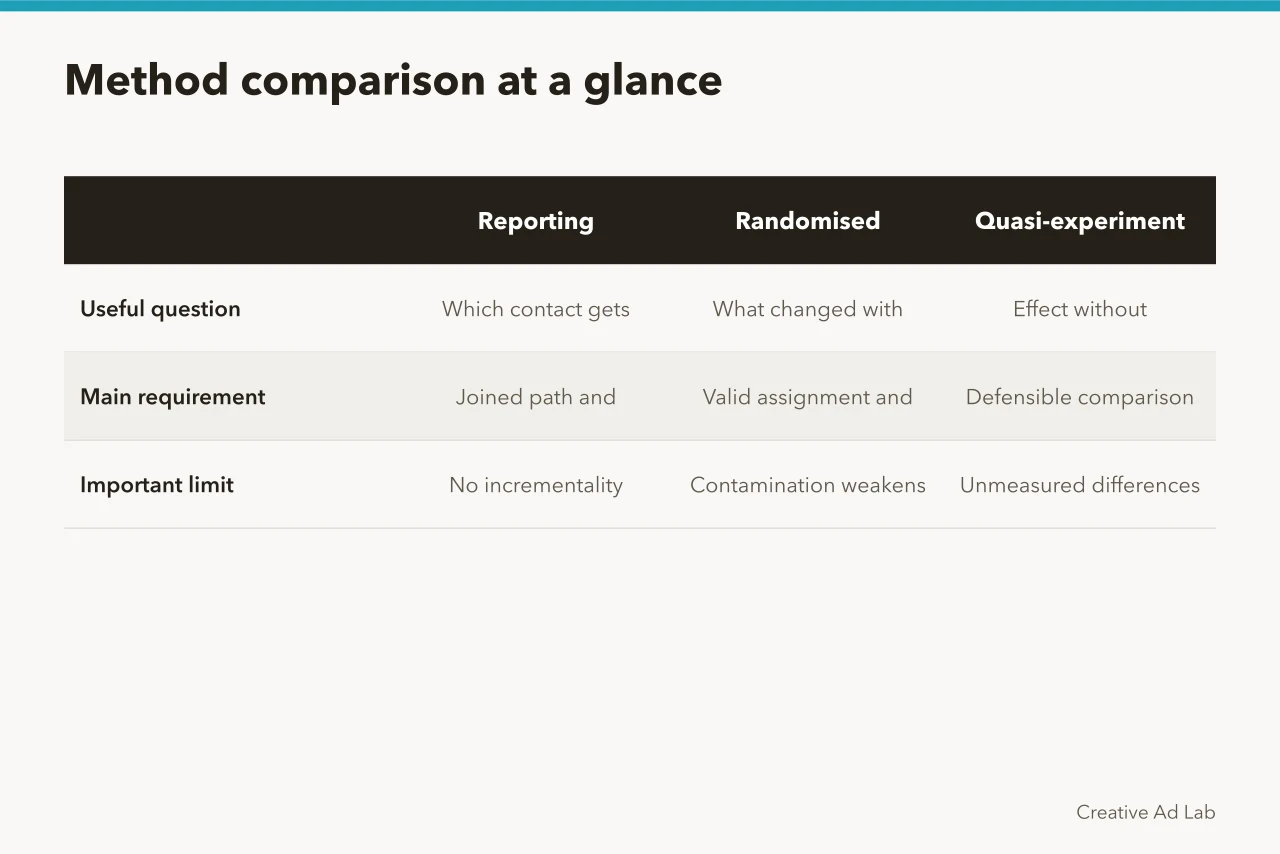
Useful question
- Last-click reporting
- Which recorded contact receives credit under a simple rule?
- Data-driven platform attribution
- How does this system distribute credit across observed interactions?
- Randomised experiment
- What changed when eligible units were assigned to treatment rather than control?
- Quasi-experiment
- What is the estimated effect when randomisation was not feasible?
- Contribution analysis
- Is the evidence consistent with the planned route to an outcome?
Main requirement
- Last-click reporting
- Joined path and outcome records
- Data-driven platform attribution
- Sufficient eligible platform data and stable configuration
- Randomised experiment
- Valid assignment, adequate exposure and protected control
- Quasi-experiment
- Defensible comparison group, pre-period evidence and specialist analysis
- Contribution analysis
- Theory of change and evidence from several sources
Important limit
- Last-click reporting
- Overlooks earlier contacts and does not estimate incrementality
- Data-driven platform attribution
- Modelled allocation is not an independent causal result
- Randomised experiment
- Contamination or unequal delivery can weaken inference
- Quasi-experiment
- Unmeasured differences may remain
- Contribution analysis
- Supports a reasoned contribution claim, not sole causation
Reporting rules are operational tools
Google Ads documents last-click and data-driven attribution for conversion actions. The setting affects its conversions columns and bidding. Google Analytics separately explains its current attribution models and lookback settings. Both are first-party records. Neither demonstrates how many actions would have happened without the advertising.
Use a reporting model when the immediate job is reconciliation, path analysis or internal allocation. Record the platform, property, event, model, lookback window and extraction date. A change in any of them breaks a simple before-and-after series unless it is marked and recalculated appropriately.
Experiments answer a narrower, stronger question
Random assignment can create a comparison in which exposure is the intended systematic difference. Google's current custom experiments documentation describes traffic and budget splits, while warning that auction exposure can still differ. Feature eligibility and implementation must be checked inside the relevant account.
For a creative comparison, change one decision that matters, such as the authorised message treatment, and keep audience, offer, bidding and period as stable as the design permits. Predefine the primary outcome, stopping rule and exclusions. Inspect actual exposure and do not discard inconvenient units after seeing results.
Quasi-experiments need an argued comparator
The 2026 Magenta Book analytical annex covers experimental and quasi-experimental impact methods. It is government guidance, not a recipe that automatically validates private advertising analysis.
A matched-area or interrupted time-series design can be useful where randomisation is impractical. The analyst must explain why the comparator tracks the treated group, test pre-period patterns and examine concurrent changes. Geography alone does not make two English areas comparable; media supply, seasonality and business conditions may differ.
Make the decision proportionate
Use platform allocation for day-to-day reporting, but label it as attribution. Commission an experiment when a material creative decision can be isolated and enough eligible delivery exists. Consider quasi-experimental work for consequential questions with a plausible comparator and specialist capability.
Keep the finding inside its tested boundary. One treatment, audience and period cannot prove a universal creative rule. The final record should state the method, estimate, uncertainty, deviations and the next action the evidence actually supports.
Before you act
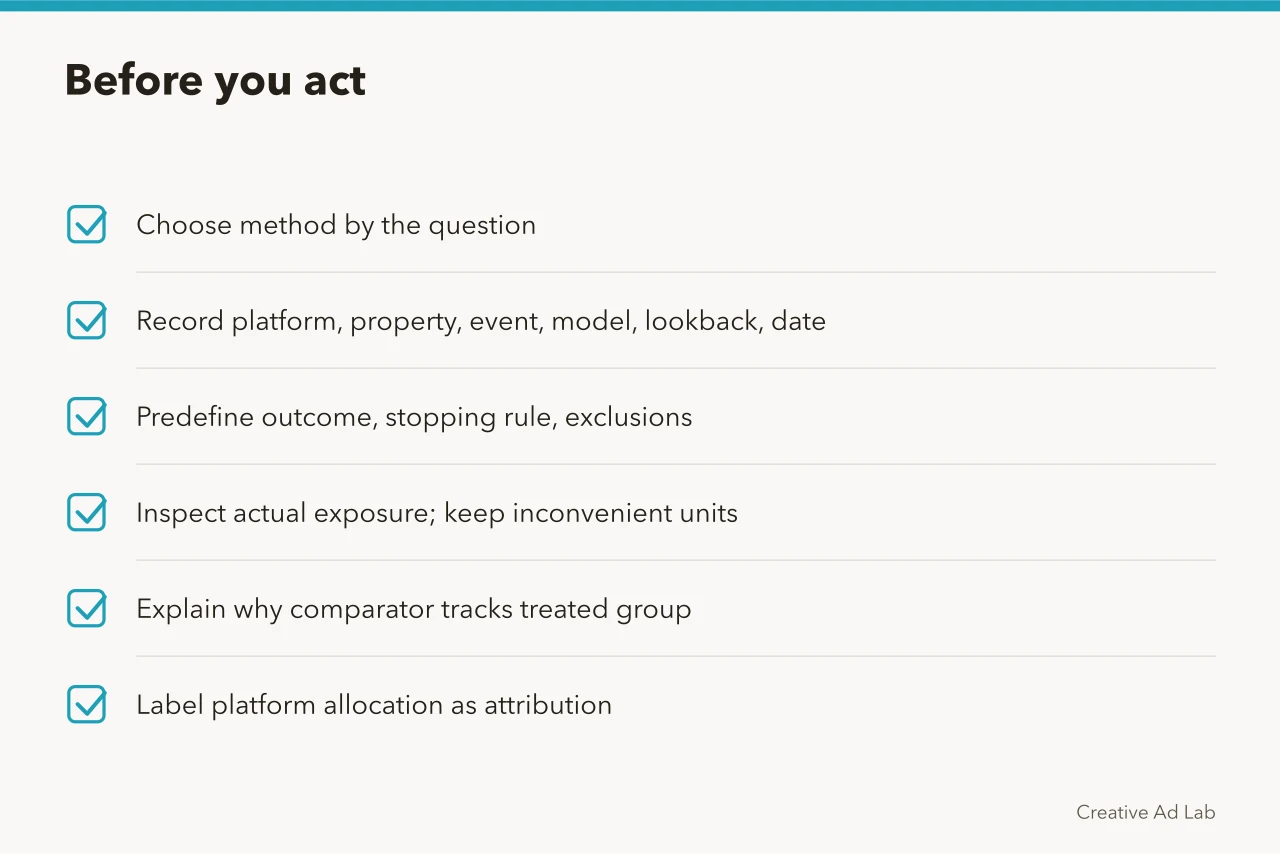
- Choose the method by the question you need to answer.
- Record the platform, property, event, model, lookback window and extraction date.
- Predefine the primary outcome, stopping rule and exclusions before the experiment.
- Inspect actual exposure and do not discard inconvenient units after seeing results.
- Explain why the comparator tracks the treated group and test pre-period patterns.
- Label platform allocation as attribution, not as an independent causal result.
Common questions
What can platform attribution actually prove?
It shows how a system distributes credit across observed interactions, using first-party records. It does not demonstrate how many actions would have happened without the advertising. Use it for reconciliation, path analysis or internal allocation, and label it as attribution rather than an independent causal result.
When is a randomised experiment the better choice?
Use an experiment when a material creative decision can be isolated and enough eligible delivery exists. Random assignment can create a comparison in which exposure is the intended systematic difference. Change one decision that matters and keep audience, offer, bidding and period as stable as the design permits.
What makes a quasi-experiment credible?
The analyst must explain why the comparator tracks the treated group, test pre-period patterns and examine concurrent changes. Geography alone does not make two English areas comparable, since media supply, seasonality and business conditions may differ. Unmeasured differences may still remain, so treat the estimate as bounded.