Reviews
Part of Marketing attribution reviews: a gated test framework
Why an empty attribution agency dossier gets no verdict
A transparent readiness review for an empty attribution-agency dossier, explaining required evidence, untested areas and why no verdict is possible.
There is no agency review to publish from the material supplied. No legal entity, named service, edition or statement of work was submitted, and no permissioned client reference or test environment exists. The result is an evidence-readiness HOLD, not a negative verdict on any agency.
The review subject is the empty dossier for a proposed marketing-attribution service to an organisation in England, and the evidence cut-off was 6 September 2026.
The publisher's editorial research function desk-checked the dossier; its reviewer is not presented as an agency user, statistician or lawyer. No hands-on work, demonstration, interview, purchase or fixture test occurred. No sponsorship, affiliate funding or supplier relationship was declared.
What to take away
- An empty attribution dossier produces an evidence-readiness HOLD, not a negative verdict on any agency.
- The dossier must name the legal entity, exact service, delivery geography, subcontractors and accountable delivery lead.
- The proposed work must choose its attribution job before any review can proceed.
- No live or synthetic test has been carried out, so the test record remains entirely untested.
- The record can reopen when a buyer supplies the legal entity, references, contract pack and test plan.
What the dossier must identify
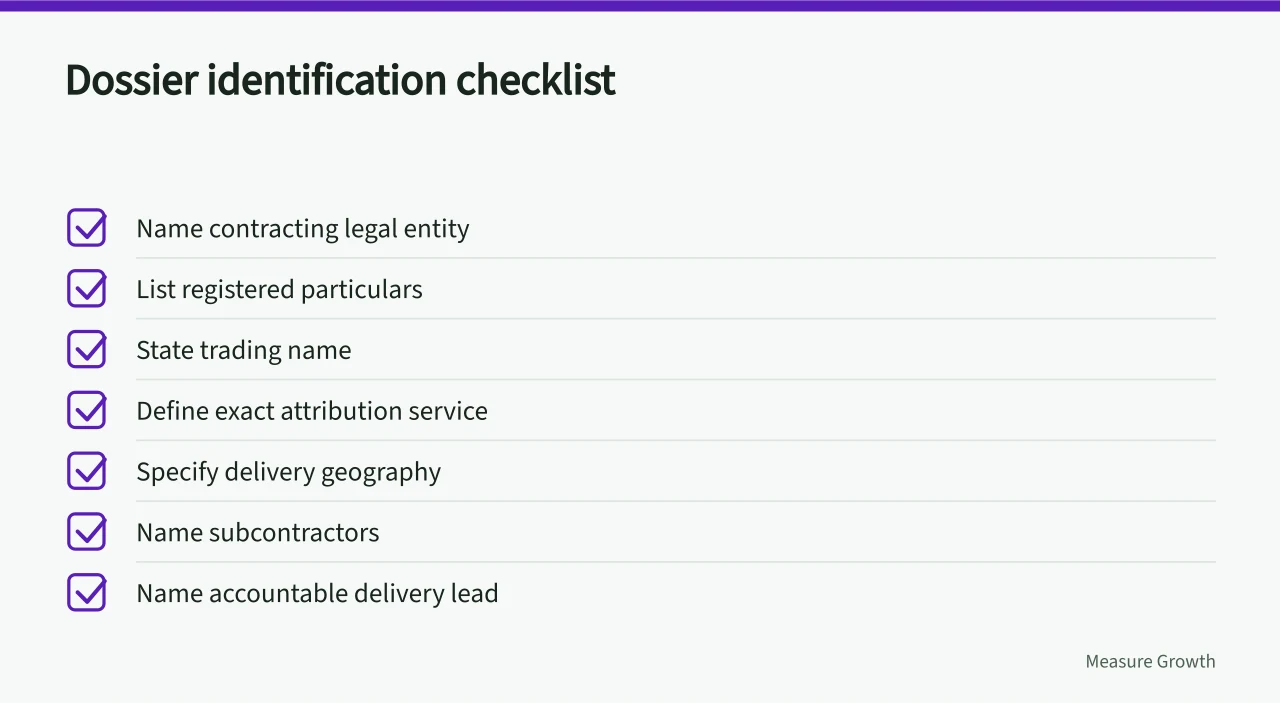
The first page should name the contracting legal entity, registered particulars where relevant, trading name, exact service, delivery geography, subcontractors and accountable delivery lead. A Companies House entry can support filed company details. Companies House describes the public register and the information companies provide, but registration alone says nothing about analytical quality, current staff or fitness for the instruction.
Attribution job types
Platform-credit reporting
- Data inputs
- Platform logs
- Outputs
- Credit reports
- Uncertainty
- Platform bounds
Data reconciliation
- Data inputs
- Source records
- Outputs
- Reconciled sets
- Uncertainty
- Match rates
Marketing mix modelling
- Data inputs
- Aggregate spend
- Outputs
- Model estimates
- Uncertainty
- Model intervals
Causal experiment support
- Data inputs
- Experiment data
- Outputs
- Causal effects
- Uncertainty
- Design-based
The proposed work must also choose its attribution job. Platform-credit reporting, data reconciliation, marketing mix modelling and causal experiment support are different services. The statement of work should define data inputs, identity and missingness, outputs, model versions, uncertainty, corrections, acceptance, intellectual property, support and exit.
Evidence needed before a review
A permissioned reference should match the proposed work closely enough to answer a declared question. Record the referee's role, service date, scope, method, limitations and permission to retain or publish the response. Do not copy confidential client information or treat a testimonial as a controlled result.
Reference evidence record
- Record referee's role
- Record service date
- Record scope
- Record method
- Record limitations
- Record permission to retain or publish
The Competition and Markets Authority's business and agency guidance on reviews was updated after the unfair-commercial-practices provisions of the Digital Markets, Competition and Consumers Act 2024 came into force. It provides UK consumer-protection context for honest review practices. Qualified counsel must determine how any actual publication falls within current law.
Ask separately for analytical work papers, change records, security evidence, accessibility evidence and contract terms. The National Cyber Security Centre's supplier assurance questions offer a starting point for security enquiries, including remote access and independent assurance. Supplier answers remain bounded to their stated systems, dates and scope.
The unperformed test record
No live or synthetic test has been carried out. The following remain untested:
- authorised data intake and deletion;
- event and identity reconciliation;
- missing, duplicate, late and corrected records;
- model reproducibility and uncertainty;
- distinction between credited and incremental outcomes;
- role-based access, logs and incident response;
- accessible reports and support routes; and
- export, continuity and termination.
A future test should use synthetic or specifically authorised fixtures and predeclared expected states. It must not expose client data merely to complete a review.
Before that test begins, the buyer should identify who can stop it, how exceptions will be recorded and what evidence proves that test data was removed. Those controls belong to the instruction and cannot be inferred from an agency's general capability statement.
Verdict and expiry
Verdict: HOLD because the review subject and evidence are absent. No score, recommendation or ranking is possible, and no adverse inference should be drawn about any unnamed agency.
The record can reopen when a buyer supplies the legal entity, exact service, comparable references, current contract pack and a permissioned test plan. Named statistics, privacy and PECR, security, accessibility, procurement and legal reviewers must then assess their own gates. Any later verdict expires when the service scope, delivery team, subcontractor chain, method or material term changes.
Before you act
- Name the contracting legal entity and registered particulars.
- Define the exact attribution service and statement of work.
- Obtain a permissioned reference matching the proposed work.
- Request analytical work papers, security and accessibility evidence.
- Predeclare expected states before any synthetic test begins.
- Identify who can stop the test and how exceptions are recorded.
Common questions
Why does the article reach a HOLD rather than a negative verdict?
No legal entity, named service, edition or statement of work was submitted, and no permissioned client reference or test environment exists. The article states the result is an evidence-readiness HOLD, not a negative verdict on any agency.
What must the first page of the dossier identify?
It should name the contracting legal entity, registered particulars where relevant, trading name, exact service, delivery geography, subcontractors and accountable delivery lead. A Companies House entry can support filed company details but says nothing about analytical quality or fitness.
What controls belong to the instruction before a test begins?
The buyer should identify who can stop the test, how exceptions will be recorded and what evidence proves test data was removed. The article says those controls belong to the instruction and cannot be inferred from a general capability statement.