
Audience research
B2B attribution in Manchester compared with the Thames Valley
Attribution software in Manchester and the Thames Valley differs on funnel length, offline touchpoints and CRM evidence requirements, plus ICO B2B rules.
What to take away
- Attribution software in Manchester and the Thames Valley is solving the same problem against different funnel lengths, so a single model rarely fits both.
- Manchester deals are shorter and more agency-mediated; Thames Valley deals run longer, with more offline touchpoints before a signed contract.
- CRM evidence requirements bite hardest in the Thames Valley, where enterprise procurement leaves a longer paper trail to reconcile.
- The ICO B2B marketing guidance applies equally in both clusters, so consent, legitimate interests and PECR rules travel with the data, not the postcode.
- Both clusters need a written model before a vendor demo, and a manual baseline before any platform migration.
Two named UK technology clusters: Manchester and the Thames Valley
Manchester and the Thames Valley are the two clusters most often compared by B2B marketing operations teams outside London. They differ in sector mix, deal size and how much of the buying process happens away from a browser.
Manchester's digital economy leans on ecommerce, media, fintech and a dense agency sector. Deals often start through a partner, an event or a referral, then move quickly to a short evaluation. The city's agency presence makes it a useful place to test attribution delivery models that rely on third parties feeding data back.
Thames Valley B2B marketing is shaped by software, hardware, life sciences and professional services along the M4 corridor. Buyers there are frequently larger organisations with procurement, legal and security review stages. That stretches the gap between first touch and closed won.
Neither cluster is a monolith. A Manchester scale-up selling to a Reading enterprise behaves more like a Thames Valley vendor than a Manchester one. Cluster is a starting hypothesis, not a verdict, which is why defining an attribution target audience comes before choosing a model.
Labour market data from the Employment and employee types - Office for National Statistics helps size the addressable buyer population in each region, though it measures employment rather than marketing intent. Use it to sanity-check territory plans, not to set conversion rates.
Funnel length and offline touchpoints compared
Funnel length is the elapsed time and the number of recorded stages between first known touch and closed won. It drives your attribution window, your lookback rules and how much credit a late-stage demo should receive.
Manchester vs Thames Valley funnels
Manchester
- Funnel length
- One to two quarters
- Buying committee
- Smaller, fewer sign-offs
- Offline touchpoints
- Agency intros, networking
- Attribution window
- Shorter window fits
Thames Valley
- Funnel length
- Two to four quarters
- Buying committee
- Larger, procurement involved
- Offline touchpoints
- Field events, exec dinners
- Attribution window
- 90 days drops first touch
Manchester funnels are typically shorter. A prospect may see a paid search ad, attend a meetup, take a demo and sign within a quarter. Fewer people are involved, so the buying committee is easier to reconstruct from CRM records.
Thames Valley funnels are typically longer. A pilot, a security questionnaire, a procurement review and a board sign-off can each sit between the demo and the contract. Attribution windows set to 90 days will silently drop the touch that started the deal.
Offline touchpoints matter more in the Thames Valley. Field events, executive dinners, partner introductions and phone calls carry weight that a web tag never sees. In Manchester, offline touches cluster around agency introductions and local networking.
The practical consequence is that offline touchpoints need a capture route. If a field event or a call is not logged against the opportunity, no model can attribute it, however sophisticated the platform.
Manchester
- Typical funnel length
- One to two quarters
- Buying committee
- Smaller, fewer sign-offs
- Offline touchpoints
- Agency intros, local events
- CRM evidence
- Contact and activity records
- Common model bias
- Last touch and first touch
Thames Valley
- Typical funnel length
- Two to four quarters
- Buying committee
- Larger, procurement involved
- Offline touchpoints
- Field events, exec dinners, calls
- CRM evidence
- Full opportunity, contract and approval trail
- Common model bias
- Multi-touch with long windows
Named tool comparison for this article: Manchester shortlist includes HubSpot, Google Analytics 4, LinkedIn Ads and Microsoft Advertising. Thames Valley shortlist includes Salesforce, Microsoft Dynamics 365, Adobe Marketo Measure, Dreamdata and HubSpot.
Typical planning ranges where no public figure exists: 90 to 120 days for Manchester and 180 to 270 days for the Thames Valley. These are example shortlists and planning ranges, not published market shares or benchmarks.
CRM evidence requirements for B2B attribution in each cluster
CRM evidence requirements are the fields and records that must exist before a touch can be credited. They are stricter than most teams assume, because a platform can only reconcile what the CRM actually stores.
CRM evidence required per cluster
Manchester
- Contact identity
- Required
- Campaign source
- Required
- Activity history
- Required
- Opportunity stage dates
- Required
- Opportunity-account links
- Not essential
- Buying group member
- Not essential
- Quotes and SOWs
- Not essential
Thames Valley
- Contact identity
- Required
- Campaign source
- Required
- Activity history
- Required
- Opportunity stage dates
- Required
- Opportunity-account links
- Required
- Buying group member
- Required
- Quotes and SOWs
- Required
In Manchester, the minimum viable set is usually contact identity, campaign source, activity history and opportunity stage dates. Deals move fast enough that gaps are recoverable through a short retrospective review.
In the Thames Valley, the same set is not enough. Enterprise deals generate quotes, statements of work, security reviews and approval chains. Attribution needs opportunity-level and account-level links, plus a way to record which touch belongs to which buying group member.
Both clusters share a common failure: marketing touches logged on the contact, revenue recorded on the opportunity, and no reliable join between them. Fix the join before you argue about credit.
The ICO's guidance on Controllers and processors | ICO matters here, because vendor contracts decide who is accountable for the data flowing into the model. Get that role split in writing before a pilot starts.
B2B marketing rules that shape what can be claimed
The Business-to-business marketing | ICO guidance sets out how UK GDPR and PECR apply when you market to organisations rather than individuals. It is the same rulebook in Manchester and the Thames Valley, and it constrains what your attribution data can lawfully contain.
Sole traders and some partnerships count as individuals for PECR purposes, so a corporate email address is not automatically fair game. Consent and legitimate interests need a documented basis, not an assumption baked into a data import.
Attribution software often ingests personal data from forms, call logs and event lists. Each source needs a lawful basis, a retention period and a route for handling subject requests. A model that cannot explain where a record came from will struggle under scrutiny.
The UK regime is not identical to EU GDPR. The Data Protection Act 2018 sits alongside UK GDPR, and PECR governs electronic marketing separately. Teams copying EU playbooks into a Manchester or Reading operation should check the UK position first.
Rules on claims also matter. Advertising claims about performance need evidence, and benchmark figures should state source, date and sample. Publishing attribution benchmark numbers without that context is a risk, not a shortcut.
Practical steps for B2B teams in Manchester
- Write the model on one page before any vendor conversationwindow, stages, credit split and exclusions.
- Map your agency and partner introductions, then agree how each one is logged against the opportunity.
- Build a manual baseline from CRM exports for one quarter, so you know what good looks like.
- Pilot with one product line and a short window, then compare the model against the baseline.
- Review monthly, and retire any rule that has not changed a decision.
Manchester teams should also resist the temptation to copy a Thames Valley configuration wholesale. A 180-day window on a two-quarter funnel will attribute touches that had no influence.
Manchester attribution readiness checklist
- Model window agreed and documented
- Agency and partner touches captured
- CRM join between contact and opportunity tested
- Manual baseline produced for one quarter
- Lawful basis recorded for each data source
- Review date set with a named owner
Use attribution buyer personas as hypothesis cards rather than fixed segments. Manchester buying committees change quickly, and a persona that never retires will quietly distort your reporting.
Before committing budget, work through attribution metrics with complete cards, so each number has an owner, a source and a decision rule attached.
- Model window agreed and documented
- Agency and partner touches captured
- CRM join between contact and opportunity tested
- Manual baseline produced for one quarter
- Lawful basis recorded for each data source
- Review date set with a named owner
Practical steps for the Thames Valley
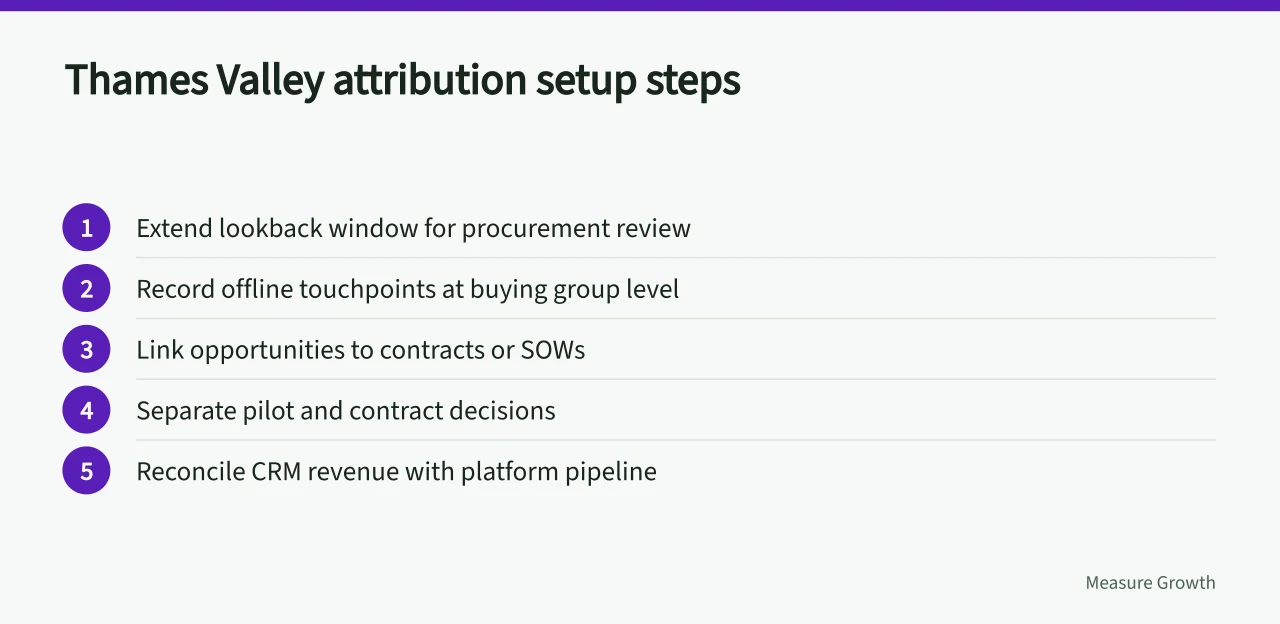
- Extend the lookback window to cover procurement and security review, then test whether it changes credit.
- Record offline touchpoints at the buying group level, not just the primary contact.
- Link each opportunity to a contract or statement of work so late-stage evidence is traceable.
- Separate the pilot decision from the contract decision, and attribute to both.
- Run a quarterly reconciliation between CRM revenue and platform-reported pipeline.
Thames Valley teams usually have more data and less agreement about it. A reconciliation ritual settles arguments faster than another dashboard.
When comparing platforms, start from selecting attribution software after the brief and the manual baseline exist. Vendors respond better to a defined problem than to a feature checklist.
Both clusters should document the controller and processor split for every tool in the stack. That single document prevents most contract disputes later.